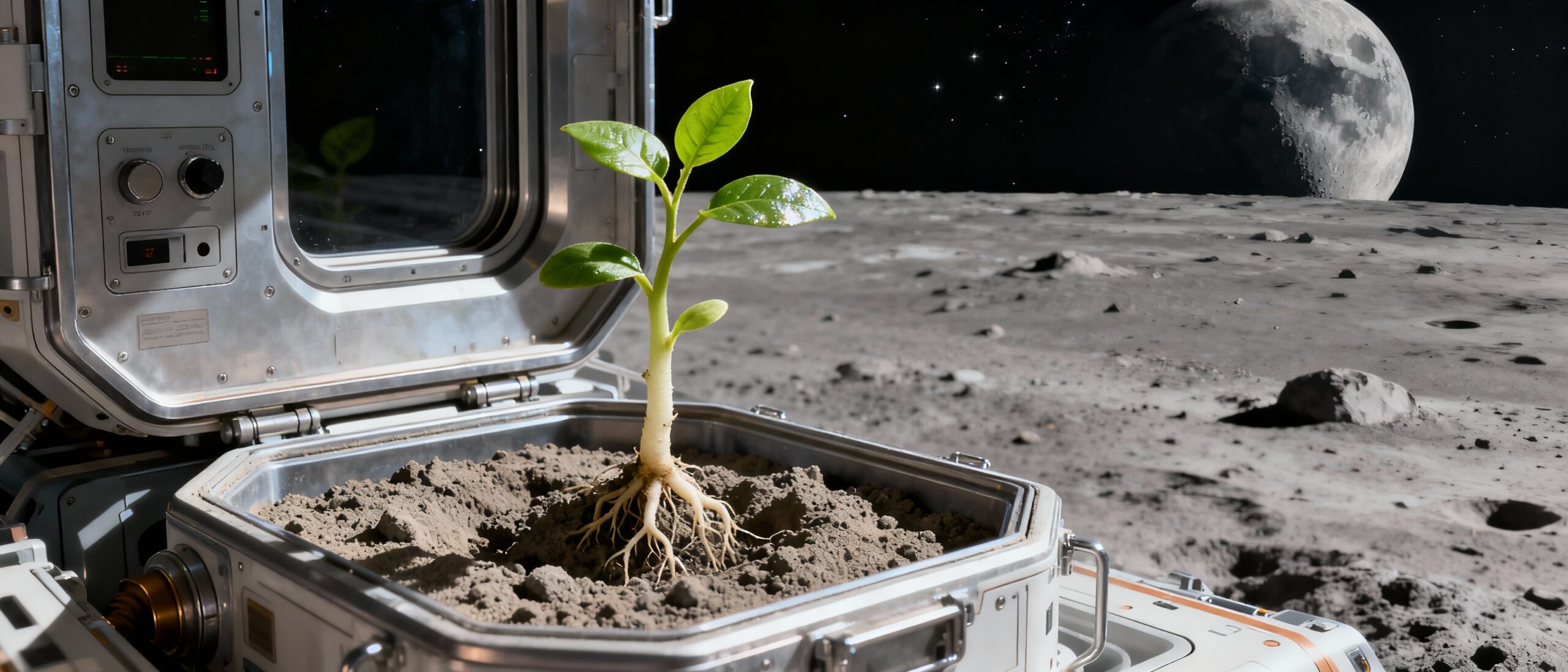
On January 3, 2019, China made history when its Chang’e-4 mission became the first spacecraft to land on the far side of the Moon. Only a few days later, the mission marked another remarkable achievement—sprouting the first-ever seeds on the lunar surface. This quiet but profound moment represents humanity’s first step toward cultivating life beyond Earth.
A Miniature Biosphere on the Moon
Packed inside the Chang’e-4 lander was a small cylindrical biosphere containing seeds of cotton, potato, and rapeseed, along with yeast and fruit fly eggs. This self-contained “mini-ecosystem” was designed to test whether basic biological processes like germination and respiration could occur in the Moon’s harsh environment. The experiment was led by scientists at Chongqing University, who engineered the sealed container to balance light, temperature, and air to sustain life within the micro-ecosystem.
Within days, camera images sent back to Earth confirmed something extraordinary: a cotton seed had sprouted. For the first time in history, a plant had germinated on another world.
Why This Matters for Human Exploration
This small green shoot symbolized far more than a biological achievement. It demonstrated that living organisms could begin to grow in extraterrestrial conditions, paving the way for future lunar or Martian habitats. Understanding how plants respond to lower gravity, higher radiation, and closed ecological systems is essential for long-term human survival beyond Earth.
Future missions will need to refine these experiments to maintain sustainable growth cycles, recycle waste, and manage energy efficiently. The Moon offers a unique laboratory to test these systems before applying them to more distant worlds like Mars.
Challenges and Lessons Learned
Unfortunately, the lunar night soon followed—two weeks of frigid darkness where temperatures plunge below -170°C. Despite insulation efforts, the tiny plant could not survive the intense cold. Yet the short-lived sprout marked the beginning of a new scientific era: one where agriculture meets astrobiology on alien worlds.
The Chang’e-4 experiment taught scientists crucial lessons about thermal insulation, container design, and biosphere management under extreme conditions. Future experiments may use improved enclosures heated with solar energy or buried habitats to retain warmth.
Looking Ahead
China’s accomplishment not only advanced its lunar program but also inspired international collaboration in astro-biology. As nations plan new missions to the Moon—both robotic and crewed—the vision of sustainable lunar bases becomes a little more tangible. Growing plants on the Moon may one day help humans produce oxygen and fresh food where none naturally exists.
From that fragile cotton sprout on the far side of the Moon, a new chapter began in the story of life—and how it might spread, adapt, and thrive beyond our home planet.